
September 15, 2026
Badminton Doubles Rules Explained: A Simple Guide for Players
July 28, 2026/Posted by Engagesports/Updated : July 28, 2026
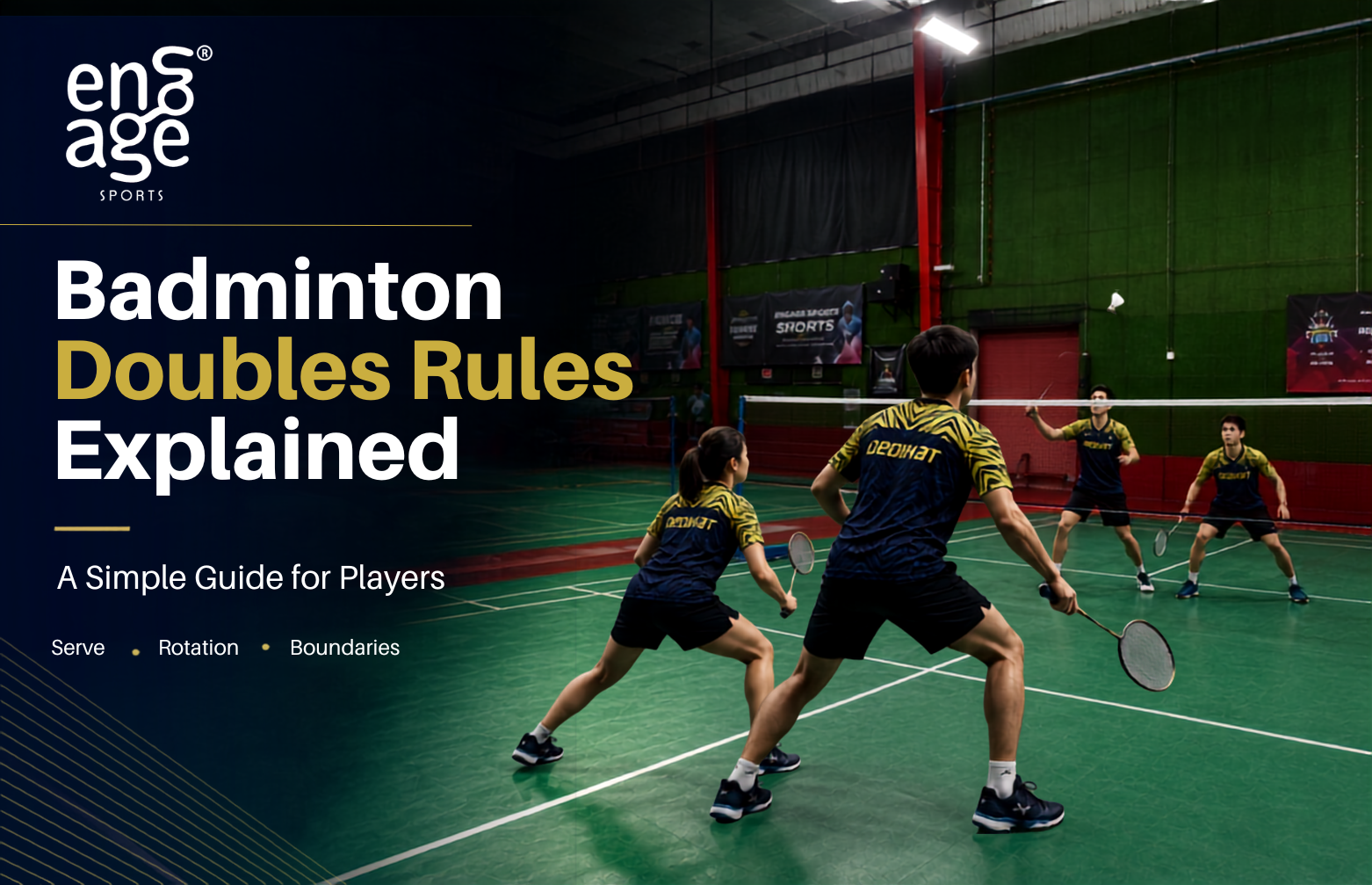
Badminton doubles is fast, exciting and highly social, but it can also become confusing when nobody remembers who should serve next.
You may start the game confidently, play a few good rallies and then suddenly hear:
“Whose serve is it?”
“Should I serve from the left or right?”
“Is the back line in or out?”
These questions are completely normal, especially for new and recreational players. Doubles has a few additional rules covering service rotation, court positions and boundaries, but once you understand the basic system, everything becomes much easier.
Here is a practical guide to badminton doubles rules, explained in the same simple way we would explain them to players at Engage Sports Arena.
How Do You Win a Badminton Doubles Match?
Under the current official rules, a badminton match is normally played as the best of three games.
Each game is played to 21 points, and the first team to win two games wins the match.
Every rally matters. Except when a let is called, the team that wins the rally scores one point, regardless of which team served.
When the score reaches 20–20, one team must gain a two-point lead to win the game. For example, 22–20 or 25–23.
However, the game cannot continue beyond 30 points. If the score reaches 29–29, the team that wins the next rally wins the game 30–29.
Which Court Lines Are Used in Doubles?
The doubles court changes slightly depending on whether the shuttle is being served or a rally is already in progress.
During the serve
The doubles service court is:
* Wide, using the outer doubles side line
* Shorter at the back, using the doubles long service line
* Served into diagonally
The area between the doubles long service line and the back boundary line is out during the serve.
During the rally
Once the serve has been returned, the full doubles court is used. This means the outer side lines and the full back boundary are in play.
An easy way to remember it is:
Short and wide during the serve. Full length and full width during the rally.
The boundary lines form part of the court, so a shuttle landing on a line is considered in.
Which Side Should You Serve From?
Your team’s score determines which service court you use.
* When your score is even - 0, 2, 4, 6 and so on - you serve from the right service court.
* When your score is odd - 1, 3, 5, 7 and so on - you serve from the left service court.
The serve must travel diagonally into the correct service court on your opponent’s side.
The rule depends on your team’s score, not your individual score.
How Does Serving Rotation Work?
This is the part that causes the most confusion, but the basic principle is simple.
When the serving team wins the rally
The serving team scores a point.
The same player serves again, but from the opposite service court because the team’s score has changed from even to odd or from odd to even.
The serving partners change service courts only when they win a point while serving.
When the receiving team wins the rally
The receiving team scores a point and becomes the new serving team.
The players on that team do not immediately swap positions. The player standing in the correct service court according to the new score serves next.
For example:
* Even score: serve from the right
* Odd score: serve from the left
Players should not serve or receive out of turn, and the original service order continues throughout the game.
Where Can Players Stand During the Serve?
The server and receiver must stand inside diagonally opposite service courts.
They must not touch the service-court boundary lines, and part of both feet must remain stationary and in contact with the court from the start of the service until the shuttle is hit.
The two partners who are not directly serving or receiving may stand anywhere on their respective side of the court, provided they do not block the server’s or receiver’s view.
Once the serve has been returned, all four players may move freely anywhere on their side of the court.
What Makes a Serve Legal?
A legal badminton serve must meet several requirements:
* The server and receiver must stand in diagonally opposite service courts.
* The server must initially hit the base of the shuttle.
* The entire shuttle must be below 1.15 metres from the court surface when it is struck.
* The racket must continue moving forward once the service begins.
* The shuttle must travel upwards, cross the net and land inside the correct service court if it is not intercepted.
The old description of serving “below waist height” is no longer the official BWF measurement. The current service-height rule is 1.15 metres.
Common Badminton Doubles Faults
A fault immediately ends the rally and gives a point to the opposing team.
Some common faults include:
* Serving from the wrong service court
* Serving above the permitted height
* Stepping on a service-court line while serving or receiving
* Serving outside the correct diagonal service box
* The shuttle failing to cross the net
* The shuttle landing outside the court
* A player or racket touching the net during a rally
* Hitting the shuttle twice
* Both partners hitting the shuttle one after the other
* Deliberately distracting or obstructing an opponent
A shuttle touching the net during a serve is not automatically a fault. When it crosses the net and lands inside the correct service court, play continues.
What Is a Let?
A let means the rally is stopped and replayed.
No point is awarded, and the same player serves again.
A let may be called when:
* The server serves before the receiver is ready
* Both the server and receiver commit a fault during the serve
* An unexpected shuttle or object enters the court
* Play is interrupted by an unforeseen situation
* The shuttle breaks apart during the rally
* The shuttle becomes caught on the net after the service has been returned
A serve that touches the net and lands correctly is legal and should not be replayed.
When Do Players Change Ends?
Players change ends:
* At the end of the first game
* At the end of the second game when a third game is required
* During the third game when one team first reaches 11 points
Changing ends helps balance possible differences in lighting, airflow or court conditions.
How Long Are the Breaks?
Under official badminton rules, players are allowed:
* Up to 60 seconds when the leading score reaches 11 points in each game
* Up to 120 seconds between games
Recreational matches may follow more flexible arrangements, depending on the booking duration and agreement between the players.
Simple Doubles Strategies for Better Games
Understanding the rules prevents confusion, but good teamwork is what makes doubles enjoyable.
Communicate clearly
Use simple calls such as “mine,” “yours,” “leave” or “out.” Clear communication prevents collisions and stops the shuttle from falling between both players.
Use the correct formation
When attacking, teams commonly use a front-and-back formation. The front player covers the net while the rear player attacks from the back court.
When defending, players generally move into a side-by-side formation to cover smashes and fast drives.
Protect the middle
Many doubles rallies are lost because both players expect their partner to cover the centre. Decide who takes the shuttle based on position, forehand advantage and communication.
Keep your serve controlled
A good doubles serve should be low, accurate and difficult to attack. Practise serving close to the short service line and vary your placement occasionally to keep the receiver alert.
Practise Badminton Doubles at Engage Sports Arena
Badminton doubles becomes much easier once you start applying the rules during real games.
At Engage Sports Arena in Al Qusais, Dubai, players can enjoy purpose-built badminton courts with quality flooring, clear lighting and sufficient space for fast doubles movement.
Whether you are playing with friends, joining a social game or training to improve your competitive performance, understanding the basic rules will help you enjoy smoother matches with fewer arguments and interruptions.
Grab your partner, remember the even-and-odd service rule and put your doubles skills into practice.